Leadership and Organizational Development
How Congreso Uses Human-Centered Design to Drive Quality Improvement
 Congreso de Latinos Unidos
Congreso de Latinos Unidos is a multiservice nonprofit organization located in eastern North Philadelphia. It serves almost 14,000 people each year across more than 45 quality programs, including education, workforce development, health care, housing, and parenting services.
With an annual budget of over $28 million, Congreso manages over 150 unique contracts for its programs, approximately 80% of which are from federal, state, and local city government departments. Congreso faces ongoing challenges to streamline data and performance management oversight given the numerous funder-mandated databases, compliance requirements, and external performance standards that come with managing so many unique contracts. This challenge is not unique to Congreso—it affects many human services organizations throughout the U.S.
As part of the organizations theory of change, developed in 2018, Congreso embraced human-centered design (HCD) principles to lead a data-informed and participant-centered performance management journey. It sought to use HCD to reduce its data challenges and maximize the impact, value, and scale of its services. The organization is pairing HCD techniques and tools with continuous quality improvement (CQI) principles to help leadership and programmatic teams gain a deeper understanding of the nuanced experiences of program staff and participants, while leveraging data and performance management tools to measurably improve program outcomes.
By combining HCD and CQI, Congreso leverages the discovery, insights gathering, and experimental skillsets of HCD alongside the data-informed rigor and program management finesse of CQI principles. To do this, Congreso taught HCD techniques to all 18 of its program teams across its four programmatic divisions and created a homegrown Program Design Toolkit with more than 15 tools that are relevant to the human services sector. The tools blend of HCD skills and performance management principles that help Congreso teams understand:
- Program design
- How participants flow through the program
- How nuances in target population and program touchpoints might affect participant experience and success
Some examples from the toolkit include:
- Process flow diagrams and participant journey maps. These tools help teams visualize program elements to create shared understanding of the full program model.
- Conversion funnels. These tools show how participants flow through the program from start to finish, overlayed with key data points in the program to identify pain points or areas of fallout, where participants might encounter barriers that prevent them from moving to the next service phases
- Personas. This tool helps teams understand the unique subsets of target populations, barriers to program engagement and success, and how to design tailored solutions for equitable access to outcomes across populations.
Design Tools in Action: First-Time Homebuyer Program
These tools have proven useful for analyzing program performance. Congreso’s First-Time Homebuyer program serves as an example. Its initial model was to schedule interested participants in a general homeownership workshop for an overview of the process, then engage them in a one-on-one follow-up session for financial counseling. Upon reviewing the program’s conversion funnel data, the team noticed significantly lower attendance rates for the one-on-one sessions, alerting them to an area of fallout that needed attention. In looking at the data, the team uncovered several personas, separating participants by tier levels of credit scores as a key indicator of readiness to continue in the homeownership journey. The data showed that individuals with credit scores under 610 had the highest fallout rate.
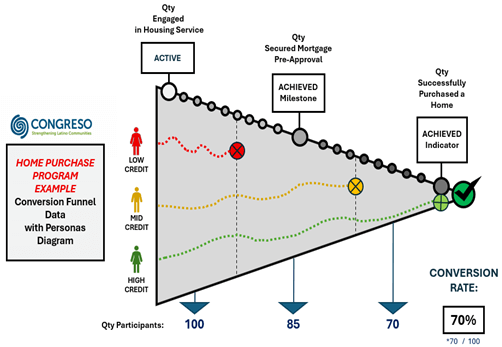
Based on these insights, the team began assessing credit scores as part of the intake process instead of the one-on-one follow-up session. The team also piloted a financial readiness program that was tailored to participants with lower credit scores, focusing on improving their credit scores as an important step before engaging in the homebuying process. Once participants increased their credit scores, they were re-engaged in the main program flow for homeownership. As a result, participant data showed noticeable improvement, and staff successfully pitched the program updates to a funder for ongoing program growth and sustainability. By overlaying CQI principles and HCD tools like conversion funnels and personas, the team identified pain points and a key area of fallout and used that information to improve participant engagement and success rate of the homeownership program.
Examples like these show the tangible benefits for participants, program teams, organization leaders, as well as funders, in embracing HCD as part of the CQI process. Program teams feel empowered to identify and analyze challenges and brainstorm solutions, which has been instrumental in Congreso’s culture shift toward participant-centered performance management. Data-informed insights and solutions empower Congreso’s leadership to support teams by allocating resources, enhancing processes, and sharing impactful stories with funders.
The homeownership program is only one of many stories of HCD providing insights, tools, and techniques for teams to brainstorm and design solutions to improve program performance and impact. Congreso has used HCD across its education, workforce, health, and family programming to better understand the staff and participant experience and believes that these HCD tools are relevant and applicable to any organization looking to enhance its CQI and performance management models.
As your organization is seeking to enhance CQI efforts, consider how process flow diagrams or participant journey maps, conversion funnels, or personas – or any other HCD techniques, might help your organization better understand the nuances of the participant experience and overlay it with your performance management philosophy to drive deeper impact.
Learn From Congreso at SPARK 2025
Congreso’s chief program officer and vice president of programmatic development will present a breakout session at SPARK 2025 on the organization’s HCD journey. Workshop participants will check out Congreso’s Human-Centered Design Toolkit, experience the tools in mini design labs, and learn how these approaches are empowering staff and program participants.
View full event details for SPARK 2025, Oct. 20-21 in Chicago, and register by Sept. 20 to receive the early bird rate.

About Congreso de Latinos Unidos
Congreso de Latinos Unidos is a nonprofit organization founded in 1977 with a mission to enable individuals and families in predominantly Latino neighborhoods to achieve economic self-sufficiency and wellbeing. In fiscal year 2024, over 13,600 unduplicated clients were served through 45+ programs focused on education, workforce development, health, housing, and family services.