
Social Current’s Executive Leadership Institute (ELI) is a yearlong leadership development program offered in partnership with Loyola University Chicago’s Quinlan School of Business. Through ELI, executives and senior managers learn how to lead more effectively in an ever-changing environment. The institute includes an in-person event, May 10-14, 2026, in Chicago; real-world projects that address a challenge at their organizations; mentorship; and more.
Over the course of the program, leaders grow their knowledge and skills to effectively manage day-to-day operations and prepare for future challenges and changes.
We are proud to spotlight the experience of ELI Alum: Oriana Carey, CEO of the Coalition for Children, Youth & Families.
Oriana and fellow ELI alumni will share their experiences and insight on the program in the webinar series, Executive Leadership Institute for Organizational Impact. Register now to join her session Jan. 8 from 2-3 p.m. ET.

Q&A With Oriana
Tell us about your background.
I started working for the Coalition in 2005 as a project manager, where I played a key role in launching the Wisconsin Foster Care and Adoption Resource Center. In 2014, I was named successor to longtime CEO Colleen M. Ellingson and stepped into the role with a strong vision for strengthening family resilience and connection across the state.
I earned my bachelor’s in social work from the University of Wisconsin–Oshkosh and master’s in social work from the University of Wisconsin–Milwaukee. I am also a licensed clinical social worker in the state of Wisconsin.
Prior to coming to the Coalition, I served in various supervisory and managerial roles within child- and family-serving organizations. My leadership is grounded in a deep commitment to ensuring that families receive meaningful, compassionate support—and to fostering a work culture where staff feel valued, engaged, and able to grow professionally.
I first learned about ELI at a Senior Leadership Conference hosted by the Alliance for Strong Families and Communities.
Can you tell us about your ELI project?
Nearly a decade ago, as part of my ELI project, I led an organization-wide effort to strengthen Coalition’s use of data to understand and communicate our impact. At the time, we were rich in activity-level information, how many families we served and what services we delivered, but lacked a clear performance framework to guide internal decision making or demonstrate outcomes to funders. My project involved researching best practices; building staff buy-in; facilitating discussions to identify needed cultural shifts; and beginning the work of defining purpose, goals, and impact measures across key program areas. That experience taught me the importance of pacing major change, managing expectations, and creating shared ownership across an organization. It continues to shape my leadership today, especially in how I approach strategic planning, performance culture, and organizational resilience.
What is something you learned at ELI that still sticks with you?
What has stayed with me most from ELI is how powerful it was to pair meaningful learning with a strong cohort of peers. The combination of new leadership tools and the support of other rising leaders shaped how I approach change, communication, and long-term organizational leadership.
How did the institute impact you as a leader?
The institute pushed me to grow in ways that prepared me for executive leadership. It sharpened my skills, broadened my perspective, and gave me the confidence to lead with greater intention when I transitioned into the CEO role.
Are there any alumni you are still in contact with?
Yes, I’ve stayed connected to ELI alumni through events and my service on the advisory council. I also remain close to one colleague from my cohort; I was able to use my professional relationships to help her connect with opportunities in Wisconsin, which led to a senior leadership role and, eventually, her becoming a CEO.
What advice would you give to someone considering ELI?
My advice is to look beyond the immediate demands on your time or budget and consider what ELI can mean for your long-term growth. It’s an investment in your leadership, your confidence, and the impact you can make in your organization.
What advice would you give to a new student before beginning the institute?
Come in with an open mind and the confidence that you belong there. Some of your peers will have more experience and some less, but you can’t predict what you’ll learn—or what you’ll offer—until you’re in it. Think long term, lean into the experience, and enjoy every moment of the learning journey that is ELI.
How has participating in ELI helped you to advance your career?
Unlike many who come to ELI, my path to the CEO role was already in motion when I participated. However, I’ve watched many of my cohort peers advance into C-suite roles, and I know ELI played a significant part in their trajectory. For me, ELI strengthened my confidence and clarified my leadership approach, giving me tools that have made a meaningful difference in navigating the ebbs and flows of my executive journey.
Learn more about ELI online and sign up to be notified when registration opens.
Social Current’s Executive Leadership Institute (ELI) is a yearlong leadership development program offered in partnership with Loyola University Chicago’s Quinlan School of Business. Through ELI, executives and senior managers learn how to lead more effectively in an ever-changing environment. The institute includes an in-person event, May 10-14, 2026, in Chicago; real-world projects that address a challenge at their organizations; mentorship; and more.
Over the course of the program, leaders grow their knowledge and skills to effectively manage day-to-day operations and prepare for future challenges and changes.
We are proud to spotlight the experience of ELI Alum: Amber Jones, Black church organizer at ISAIAH/Faith in Minnesota.
Amber and fellow ELI alumni will share their experiences and insight on the program in the webinar series, Executive Leadership Institute for Organizational Impact. Register now for sessions in this series.

Q&A
Tell us about your background.
My background is in community organizing, policy advocacy, and nonprofit leadership. I hold a master’s from Luther Seminary and a bachelor’s from the University of Minnesota-Twin Cities. At the time of my ELI experience, I was a managing director for policy at a local nonprofit in Minneapolis and had previously been a policy advisor in our Minnesota governor’s office. I have since returned to community organizing. I first learned about ELI from my previous CEO, who is also an ELI alum
Can you tell us about your ELI project?
My ELI project was creating an organizational strategy for community mobilization. This was to pair with policy advocacy and partner development as key strategies for transformation in our organization. We conceptualized our work as a ‘think-and-do tank,’ pairing the intellectual rigor of a think tank with the strategy and action of an activist organization.
My ELI project sought to discover ways we could activate the public in driving our policy solutions into implementation. In the end, I deepened internal collaboration with this in mind, socializing these concepts amongst the team. I also oversaw the buildout of a digital Action Center to encourage online advocacy actions accessible across the state.
How did the institute impact you as a leader?
ELI helped me zoom out and gain a new perspective on what executive leadership truly requires. It also helped me approach problems differently than how I’ve done in the past. It pushed me to take more accountability for how I show up as a leader, and what I offered toward solution-building.
What advice would you give to someone considering ELI?
For someone considering ELI, ensure you can create capacity in your schedule for it, as it is rigorous and intentional in investing in your growth. Gain active support from your executive leaders, using it as a way to deepen your understanding of your own organization and how you can be in service to it.
What advice would you give to a new student before beginning the institute?
Get curious about yourself and your workplace. Analyze yourself as a leader—strengths, weaknesses, challenges, opportunities. Bring that knowledge into the experience with you, and use your workplace as a laboratory during ELI. Test new concepts you’ve learned through ELI in your workplace in real time and learn from what you derive in your testing.
Learn more about ELI online and sign up to be notified when registration opens.
Social Current’s Executive Leadership Institute (ELI) is a yearlong leadership development program offered in partnership with Loyola University Chicago’s Quinlan School of Business. Through ELI, executives and senior managers learn how to lead more effectively in an ever-changing environment. The institute includes an in-person event, May 10-14, 2026 in Chicago; real-world projects that address a challenge at their organizations; mentorship; and more.
Over the course of the program, leaders grow their knowledge and skills to effectively manage day-to-day operations and prepare for future challenges and changes.
We are proud to spotlight the experience of ELI alum: Devin Burgin, vice president of the psychiatric residential treatment facilities (PRTF) program at KidsTLC.
Devin and fellow ELI alumni will share their experiences and insight on the program in the webinar series, Executive Leadership Institute for Organizational Impact. Register now to join his session, March 10 from noon-1 p.m. ET.
Q&A with Devin

Tell us about your background.
I joined KidsTLC in 2013 as a residential care facilitator in the psychiatric residential treatment facility. After serving in that capacity for two years, I became the program implementation manager. During my three years in this role, I oversaw a residential unit, was the school manager, and eventually transitioned to director of unit clinical operations, where I helped to oversee day-to-day residential operations on campus. In 2023, I transitioned to my current role as vice president of the PRTF program, where I oversee program implementation managers and supervise residential operations. I graduated with my undergraduate degree in exercise science from Pittsburg State University in 2013. I still have a huge passion for health and fitness and conduct personal training outside of KidsTLC time. I learned about ELI through my current CEO, Erin Dugan, who came across the connection through networking.
Can you tell us about your ELI project?
My capstone project is called Leadership Academy. It is a comprehensive, three-tiered program designed to cultivate leadership excellence at every level of our organization. The program emphasizes individual development, purposeful leadership, and strategic goal setting, with a focus on aligning personal growth with KidsTLC’s mission, vision, and structure. KidsTLC has been graduated 25 entry-level employees and 13 mid-level managers since starting the program.
What is something you learned at ELI that still sticks with you?
ELI opened my eyes to a lot of similar struggles in social sector work. I loved the ability to network and collaborate with so many leaders across the U.S. The ability to bounce strategies and ideas that can help not only our organization, but the entire field of work is a special collaboration.
How did the institute impact you as a leader?
I’d say it helped me be more confident overall. I believe in my leadership, but, at times, I tend to sit back and don’t always speak up. ELI gave me opportunities to step out of my comfort zone and add value where I can.
What advice would you give to someone considering ELI?
Be open, confident, and come with a learning mentality. Don’t shy away from opportunities and push yourself outside of your comfort zone, especially in relation to the capstone project.
How has participating in ELI helped you to advance your career?
Again, I’d say confidence in being a complete leader though and through and taking risks and changes when I have the opportunity. The connections and networking are what have impacted me the most. I have the ability to continue to engage with ELI through its alumni advisory group, which has been a goal of mine over the past couple years.
Learn more about ELI online and sign up to be notified when registration opens.
Social Current has released the new case study, Shifting Mindsets, Shaping Futures: Using a Proven Assessment Tool to Build an Interculturally Competent Organization, which highlights the powerful transformation underway at Children & Families First Delaware (CFF). Through the strategic use of the Intercultural Development Inventory® (IDI®) and support from Social Current, CFF has strengthened its internal culture, deepened its equity work , and enhanced its ability to serve its communities.
This case study offers an inside look at how the organization is leveraging data, partnership, and intentional practice to drive meaningful change, as well as how other organizations can do the same.
A Journey Rooted in Values and Measurable Growth
Following 2020’s national reckoning on racial justice, CFF sought a deeper, more actionable way to advance its work in growing intercultural awareness and acceptance. Through partnership with Social Current, CFF launched a multiphase implementation of the IDI®, a research-backed tool that assesses and supports intercultural competence across staff and teams.
With Social Current’s coaching, facilitation, and strategic guidance, CFF has:
- Expanded IDI® participation across leadership, aspiring leaders, and staff
- Developed individual and organizational action plans
- Updated human resources and civic engagement policies to be more culturally responsive
- Increased staff engagement
- Enhanced accessibility with materials translated into Spanish and Haitian Creole
- Gained national visibility, including presentations at SPARK and involvement in equity coalitions
“We’ve gone from talking about core values to living them,” said Dr. Julius Mullen, CFF’s chief learning and community officer. “The assessment gave us language, insight, and accountability. Social Current gave us the support to actually use it.”
Read the Full Case Study
The full case study, Shifting Mindsets, Shaping Futures, is now available for download. It provides practical insights for organizations seeking to build intercultural competence and strengthen their culture through data-informed strategies and strong partnership.
Upcoming Webinar: How Assessments Can Fuel Personal and Organizational Growth
To offer additional insight into the IDI® as an organizational tool, Social Current will host an interactive webinar, How Assessments Can Fuel Personal and Organizational Growth, on Jan. 14 from 2-3 p.m. ET.
This session will explore the power of assessment tools, like the IDI®, to strengthen leadership development, support organizational culture change, and guide strategic growth. Participants will learn how assessments can:
- Identify strengths and areas for development
- Create shared language and goals
- Build accountability and momentum
- Support more inclusive, responsive work environments
The webinar will feature Social Current experts who support organizations across the country in using assessments to spark meaningful, sustained impact.
Register now to join the conversation and learn how your organization can turn insight into action.
The social sector is currently navigating a turbulent landscape defined by funding cuts, destabilizing policy changes, and rising job insecurity. These pressures demand more than traditional management; they call for transformational leadership that balances pragmatism with vision. In times of volatility, leaders must not only safeguard organizational survival but also remain committed to the core values that bind their staff, board, and volunteers.
Sustaining morale while implementing difficult changes, such as eliminating staff positions, reducing programs, or even dissolving entire departments, necessitates balancing human sensitivity with organizational realities.
Change-ready leaders must:
- Acknowledge the human cost of these decisions and practice empathy and transparency in all communication
- Open dialogue about the reasoning behind organizational shifts to help maintain trust and minimize uncertainty
- Foster a culture of shared purpose, empowering staff to see themselves as part of the solution, rather than passive bystanders to change
This is often easier said than done, but the following practical frameworks, resources, and tools can be used to help you manage change.
The Essentials
- Change Management Requires Empathy and Transparency: Communicating the rationale behind difficult changes and practicing empathy are crucial for maintaining staff trust and morale.
- Use a Structured Change Framework: A systematic approach provides a roadmap for transformation.
- Prioritize Changes Strategically: Use a prioritization matrix to identify “quick wins” that will allow you to build momentum while planning more complex initiatives.
- Empower Your Employees: Involving employees in the change process is essential and sustains long-term change.
- Invest in Staff Development: Even during tough times, investing in professional growth builds resilience and helps both staff and the organization adapt to uncertainty.
Change Management Tools for the Adaptive Leader
There are dozens of change management frameworks and models, such as Lewin’s 3-Stage Model, the ADKAR Model, and McKinsey 7-S. Adopting a framework helps organizations approach change in a structured, consistent way that reduces uncertainty, improves communication, and increases the likelihood of successful, lasting outcomes.
Success Factors for Leading Change
For example, drawing from John Kotter’s foundational research, the following change management framework enables leaders to systematically design and sustain organizational transformation in eight key phases:
- Create a sense of urgency
- Build a guiding coalition
- Develop a clear vision and strategy.
- Communicate the vision consistently
- Empower employees and remove obstacles
- Generate short-term wins
- Sustain acceleration and build momentum
- Anchor changes in the culture
Change management frameworks can provide essential clarity and structure to your organizational change, ensuring alignment across your organization throughout every phase. In short, having an overarching change management framework improves the chances that the change will be adopted sustainably and successfully.
Prioritizing Changes
Leaders can increase the impact and longevity of change by making strategic choices about which projects to advance. When considering which changes to implement, leaders should utilize frameworks such as an Impact-Effort Prioritization Matrix, which plots possible initiatives and changes across two axes: Impact (low to high) and complexity (low to high).
| Low Complexity | High Complexity | |
| Low Impact | Quick wins build momentum and show progress. Examples: Revising forms, reducing minor costs | Avoid these where possible. They drain time without significant payoff. Example: Implementing a complex data-tracking system for a metric that has limited relevance to service outcomes. |
| High Impact | Priority actions deliver strong benefits with manageable effort. Examples: Adopting a digital client intake system | Strategic initiatives require extensive planning, resources, and staff engagement. Examples: Restructuring service delivery, merging programs |
By categorizing changes this way, leaders can identify and act on “quick wins” to maintain morale, prioritize high-impact actions that enhance efficiency, and carefully plan more complex transitions to reduce organizational fatigue.
Essential Change Management Questions for Leaders
Once you’ve decided which changes to implement, it’s crucial to approach each situation thoughtfully to determine the best course of action.
Social Current’s Senior Director of Leadership and Organizational Development Robena Spangler recommends these key questions to guide this process:
- Why change? (The rationale, need, or urgency)
- What is the change? (Specific details about what will be different)
- Who is impacted? (Specific details about who will experience change and how)
- When will it happen? (Share the timeline, milestones and key dates)
- What support is offered? (Available training, tools, resources)
- What is the benefit? (Connect the change to metrics and positive outcomes for staff, clients, and the organization)
Invest in Staff Development
Change-ready organizations should continue to prioritize staff development. Building staff skills enhances efficiency and helps to ensure employees are equipped to thrive in the evolving workplace. Consider focusing on skills such as stress management and resilience, coaching and feedback, management and leadership, trauma-informed supervision, and AI literacy.
Prioritizing professional growth also signals a commitment to staff. Ultimately, organizations that embrace transparency, strategically plan and implement change, and frame change as an opportunity for renewal while still acknowledging losses with empathy and authenticity, can emerge from crises more adaptive, resilient, and mission aligned.
Social Current provides a wide range of resources, including self-paced courses, an intensive leadership development program, the CEO convening, leadership coaching, and customized consulting solutions focused on workforce resilience. These offerings are designed to equip your team with the knowledge and skills to navigate change with confidence.
Social Current Solutions
Consultation Services & Upcoming Events
Executive Leadership Institute
Save the Date: May 10-14, 2026
The Executive Leadership Institute (ELI), offered in partnership with Loyola University Chicago’s Quinlan School of Business, prepares senior-level managers and executives to lead into the future of human services. It moves beyond traditional leadership practices to next-generation leadership practices that fuel future-ready leaders and organizations.
In addition to a weeklong in-person event, students participate in a full year of online learning, which includes interactive presentations, small-group discussions, case study analysis, and more. To help students reinforce and apply their learning, they complete self-designed projects that address an organizational challenge.
Join a free webinar to hear from a recent alumni.
CEO Convening
Save the Date: Oct. 19-21
Social Current’s CEO Convening offers learning and networking tailored to CEOs and executive directors of human and social services organizations. By bringing together leaders who truly understand each other’s day to day, it will help you develop relationships, share challenges, find solutions, and build community. With facilitated sessions, the event’s programming emphasizes dialogue and collaboration to support an organization’s top leader and identify solutions.
Individual and Team Coaching and Support
Social Current offers customized consulting related to leadership development strategies and resources, training and presentations for teams and individuals on adaptive leadership principles, and leadership coaching.
Knowledge and Insights Center Resources
Whether you’re an emerging leader navigating the complexities of the social sector or a tenured leader seeking to refine your expertise, Social Current’s Knowledge and Insights Center (KIC) is your invaluable partner. Leverage our expertly curated resources to stay at the forefront of sector trends, implement best practices, and develop your leadership skillsets.
Center for Creative Leadership On-Demand Courses: Lead into the future of your organization with these on-demand courses from the Center for Creative Leadership Series. This dynamic collection of on-demand courses provides you with the essential skills and strategies to thrive in today’s ever-evolving landscape. Enroll now in these new courses:
- Innovation Leadership: Take a deep dive into four sequential bite-sized lessons that are effective, dynamic, and structured around the four phases of the Targeted Innovation™ process: Clarify, Ideate, Develop, and Implement.
- Managing Virtual and Hybrid Teams: Leaders of virtual and hybrid teams need a strategy for thinking differently, communicating digitally, and making sure people feel included, connected, and aligned to perform at their best. In this course, develop a new mindset, skillset, and toolkit to handle the complexity and ambiguity associated with navigating virtual landscapes.
- Burn Bright: The Resilience Advantage: Peak performers in every field know that high performance and productivity do not come from blindly pushing harder and working longer. Instead, they engage in a series of small, reinforcing behaviors to manage their energy and create conditions for peak performance. This self-paced learning journey guides you through a practical, scientific, and reflective approach to regularly recharging and consistently bringing your best self at home, at work, and in your community.
Next Big Idea Book Club: Curated by bestselling authors Malcolm Gladwell, Adam Grant, Susan Cain, and Daniel Pink, this “virtual book club” highlights the most important nonfiction books of the past few years. The on-demand lessons distill groundbreaking books, so you gain a comprehensive understanding of key concepts and practices in a fraction of the time (less than 45 minutes). Impact Partners can access all our Next Big Idea courses by logging into the Social Current Learning Community.
Check out these Next Big Idea Book Club courses based on leadership books:
- Secrets to Career Success: In this course, you’ll learn the four behaviors that outstanding leaders use to drive themselves—and their organizations—forward. Next, you’ll explore three stages to becoming a CEO, plus strategies for accelerating your progress. Finally, you’ll discover common mistakes leaders make when building a team and how to avoid them.
- Getting it Done: No matter the goal, many of us start new projects or pursuits determined to make our dreams a reality. Yet too often our motivation dwindles. We give up our goals because we can’t sustain that spark that incited us to pursue them. In this module, you’ll learn proven methods for changing your circumstances and mindset to maximize self-motivation.
- Playing Well with Others: In this course, author Eric Barker advocates for examining data and research to understand others and form worthwhile, fulfilling connections. Dive into seven big ideas from Barker’s book, uncovering how to understand people better, improve friendships, and leave behind loneliness.
Business, Media, and Research Databases
From thousands of premium journals to the latest social sector news and media, Impact Partners have access to a wealth of evidence-based resources to help them overcome any leadership challenge.
- Business Books Summaries: Read concise summaries of thousands of bestselling business books to stay current and develop new leadership skills. Impact Partners can access these resources at the links below.
Access these top three leadership Business Book Summaries:
- All Pride, No Ego by J. Fielding
- Bringing Up the Boss: Practical Lessons for New Managers by R. Pacheco
- Leading in a Non-Linear World: Building Wellbeing, Strategic, and Innovation Mindsets for the Future by Gomes and Gerrard
As the social sector faces intersecting crises, including natural and social disasters, funding cuts, policy changes, and workforce challenges, adaptive leadership and change management are essential. Today’s social sector leaders must be prepared to guide their organizations through constant change and uncertainty and seize opportunities to build resilience and adapt. Adaptive leadership is not about having all the answers—it’s about empowering people to face tough realities, challenge the status quo, and co-create pathways forward. This style of leadership helps teams stay grounded in core values while responding dynamically to disruption and complexity.
The role of a leader transcends management or positional authority. It requires visionary foresight, strategic resource allocation, and empathetic communication.
Crises may not forge leaders, but they do test them. In times of crisis, organizations and communities look to their leaders to set the tone and lead by example. This means that leaders must proactively develop their communication skills, co-create comprehensive risk management and mitigation plans with stakeholders, and strengthen collaborative partnerships. To remain agile in times of stress, leaders should embrace data-driven decision-making, invest in staff development to enhance efficiency, and adopt innovative service delivery models. Crucially, maintaining transparency and fostering a shared sense of purpose will be vital for sustaining morale and service delivery during trying times.
Don’t let perfection be the enemy of effective leadership. Leaders are human and are also experiencing stressors. When faced with indecision, returning to your organization’s mission and values can provide a steady compass for decision making. Lean into trusted relationships to co-create collaborative solutions and facilitate innovation. No single person or organization holds all the answers; leading through today’s interconnected challenges requires partnering across departments, hierarchies, disciplines, and sectors.
Conclusion
Strong adaptive leadership skills are more important than ever. By investing in professional development and connecting with a community of changemakers, social sector leaders can navigate complexity with confidence, inspire their teams, and drive meaningful impact. Social Current is here to support every step of the journey.
Sources & Further Reading
- Leading Under Constraint: What Nonprofit Leaders Need to Know to Survive | Forbes
- How to Lead Through a Crisis | Center for Creative Leadership
- How to Thrive When Leaders Create Chaos in the Workplace | Forbes
- How to Build and Repair Leadership Trust in the Workplace | Training Industry
- Leadership in Polycrisis | Center for Creative Leadership
Knowledge and Insights Center Resources
Social Current’s Knowledge and Insights Center (KIC) offers leaders expertly curated resources to stay ahead of sector trends, implement best practices, and develop your leadership skills.
Learning Community
Enhance your leadership skills through a range of professional development and learning opportunities. The KIC offers live webinars, self-paced courses, trainings, and learning cohorts.
Center for Creative Leadership Series: Lead the future of your organization and unlock your full potential with these on-demand courses from the Center for Creative Leadership:
- Managing Virtual and Hybrid Teams. Leaders of virtual and hybrid teams need strategies for thinking differently, communicating digitally, and ensuring team members feel connected, included, and aligned to perform at their best. Take this course to develop the mindset, skills, and tools needed to navigate the complexity and ambiguity associated with remote and hybrid work.
- Innovation Leadership. Take a deep dive into four sequential, bite-sized lessons that are effective, dynamic, and structured around the four phases of the Targeted Innovation™ process: Clarify, Ideate, Develop, and Implement.
- Burn Bright: The Resilience Advantage. High performance and productivity aren’t about pushing harder and working longer. Instead, they come from utilizing a series of small, reinforcing behaviors to best manage your energy. This course guides participants through a practical, reflective, and science-backed approach for recharging regularly and consistently bring their best selves to all facets of their lives.
Next Big Idea Book Club (Impact Partner Exclusive): This book club features nonfiction titles curated by bestselling authors Malcolm Gladwell, Adam Grant, Susan Cain, and Daniel Pink. Through each concise, high-impact course, participants can gain a deep understanding of key concepts and practices in less than 45 minutes. Check out these books on leadership:
- Accelerating Leadership Success: Explore four behaviors that outstanding leaders use to drive personal and organizational growth. It also outlines three stages to becoming a CEO and offers strategies for accelerating leadership development. Participants will learn how to avoid common pitfalls when building and managing teams.
- The Motivation Spark that Achieves Goals: People often start new projects with optimism, only to lose motivation over time. Goals often go unfulfilled because the spark that inspired them fades. Learn proven methods for shifting your mindset and circumstances to maximize self-motivation.
- What You Know About Relationships is (Mostly) Wrong. Author Eric Barker advocates for examining data and research to better understand others and form worthwhile, fulfilling connections. Dive into seven big ideas that will help you better understand people, improve friendships, and combat loneliness.
Business, Media, & Research Databases
From thousands of premium journals to the latest social sector news and media, Social Current Impact Partners and KIC subscribers have access to a wealth of evidence-based resources to support them in addressing any leadership challenge.
Business Books Summaries. Want to learn from bestselling business authors, but don’t have time to read everything on your list? Business Book Summaries provides concise overviews of thousands of key business books to help stay current and develop new skills.
Top Business Book Summaries on Leadership:
- All Pride, No Ego by J. Fielding
- Bringing Up the Boss: Practical Lessons for New Managers by R. Pacheco
- Leading in a Non-Linear World: Building Wellbeing, Strategic, and Innovation Mindsets for the Future by Gomes and Gerrard
- The Leap to Leader by A. Bryant
- Vertical Growth by Bunting and Lemieux
The Inclusive Leader’s Recommended Reading List:
- How to Be an Inclusive Leader by Jennifer Brown
- The Power of Employee Resource Groups: How People Create Authentic Change by Farzana Nayani
- The Conversation by Robert Livingston
- Data Driven DEI by Randal Pinkett
- Elevate Connection by Kelly Waltman
Social Current Resources and Opportunities
Customizable Consulting
Social Current has deep expertise in leadership and organizational development in the social sector. We can partner with you to assess and enhance your leadership strategies and provide training for teams on adaptive leadership, change management, and building organizational resilience in times of uncertainty.
Executive Leadership Institute (ELI)
May 10-14, 2026 in Chicago
The Executive Leadership Institute’s curriculum is grounded in adaptive and change leadership strategies that will remain relevant throughout participants’ careers. It is held in partnership with Loyola University Chicago and includes the weeklong in-person event, a year of virtual learning, mentoring, and real-world projects on organizational challenges.
CEO Convening
Oct. 19-21, 2026 in Chicago
This event will offer learning and networking tailored to CEOs and executive directors of human and social services organizations. By bringing together leaders who truly understand each other’s day to day, it will help you develop relationships, share challenges, find solutions, and build community.
Three on-demand leadership courses are now available through Social Current’s online learning community. These courses are self-paced and include eight hours of learning. Participants can complete each course’s four sections over four weeks, but have access for an entire year. These trainings were developed by The Center for Creative Leadership (CCL)®, a top-ranked, global, nonprofit provider of leadership development.
Managing Virtual and Hybrid Teams
While working remotely has its advantages, it can also be challenging. Today’s leaders need to effectively lead a large spectrum of teams, including co-located, virtual teams and situations where some members are dispersed and some in the same location. These teams need a strategy for thinking differently, communicating digitally, and making sure people feel included, connected, and aligned to perform at their best. Course takeaways include:
- Increase effectiveness as a leader and/or member of a virtual/hybrid team
- Identify research-based best practices that contribute to an optimal virtual environment
- Learn and practice the mindsets, skillsets, and tools for effective virtual and hybrid leadership
- Quickly build a sense of “team” virtually when forming or joining a new team
Innovation Leadership
Effective leaders need to champion innovation. Understanding design thinking concepts can help leaders target and champion innovation more effectively. Course takeaways include:
- Discover new ideas and craft them into something new that adds value
- How to develop your ideas within your organization
- Analyze and organize new ideas through a matrixed process
- Evaluate your innovation blind spots
Burn Bright: The Resilience Advantage
This course will help leaders approach their energy and performance with a new mindset and invigorated toolset. In each of four sections, participants will complete multiple lessons designed to encourage engagement and interaction. Course takeaways include:
- Understand the importance of resilience and energy in effective leadership
- Explore a wide range of techniques to recharge and build resilience
- Develop short but impactful resilience rituals and routines that take up just 2% of your day, fend off burnout, and help you ‘burn bright’
Learn more about Social Current’s Leadership and Organizational Development expertise and solutions.
For questions and technical assistance, contact Social Current.
Congreso de Latinos Unidos is a multiservice nonprofit organization located in eastern North Philadelphia. It serves almost 14,000 people each year across more than 45 quality programs, including education, workforce development, health care, housing, and parenting services.
With an annual budget of over $28 million, Congreso manages over 150 unique contracts for its programs, approximately 80% of which are from federal, state, and local city government departments. Congreso faces ongoing challenges to streamline data and performance management oversight given the numerous funder-mandated databases, compliance requirements, and external performance standards that come with managing so many unique contracts. This challenge is not unique to Congreso—it affects many human services organizations throughout the U.S.
As part of the organizations theory of change, developed in 2018, Congreso embraced human-centered design (HCD) principles to lead a data-informed and participant-centered performance management journey. It sought to use HCD to reduce its data challenges and maximize the impact, value, and scale of its services. The organization is pairing HCD techniques and tools with continuous quality improvement (CQI) principles to help leadership and programmatic teams gain a deeper understanding of the nuanced experiences of program staff and participants, while leveraging data and performance management tools to measurably improve program outcomes.
By combining HCD and CQI, Congreso leverages the discovery, insights gathering, and experimental skillsets of HCD alongside the data-informed rigor and program management finesse of CQI principles. To do this, Congreso taught HCD techniques to all 18 of its program teams across its four programmatic divisions and created a homegrown Program Design Toolkit with more than 15 tools that are relevant to the human services sector. The tools blend of HCD skills and performance management principles that help Congreso teams understand:
- Program design
- How participants flow through the program
- How nuances in target population and program touchpoints might affect participant experience and success
Some examples from the toolkit include:
- Process flow diagrams and participant journey maps. These tools help teams visualize program elements to create shared understanding of the full program model.
- Conversion funnels. These tools show how participants flow through the program from start to finish, overlayed with key data points in the program to identify pain points or areas of fallout, where participants might encounter barriers that prevent them from moving to the next service phases
- Personas. This tool helps teams understand the unique subsets of target populations, barriers to program engagement and success, and how to design tailored solutions for equitable access to outcomes across populations.
Design Tools in Action: First-Time Homebuyer Program
These tools have proven useful for analyzing program performance. Congreso’s First-Time Homebuyer program serves as an example. Its initial model was to schedule interested participants in a general homeownership workshop for an overview of the process, then engage them in a one-on-one follow-up session for financial counseling. Upon reviewing the program’s conversion funnel data, the team noticed significantly lower attendance rates for the one-on-one sessions, alerting them to an area of fallout that needed attention. In looking at the data, the team uncovered several personas, separating participants by tier levels of credit scores as a key indicator of readiness to continue in the homeownership journey. The data showed that individuals with credit scores under 610 had the highest fallout rate.
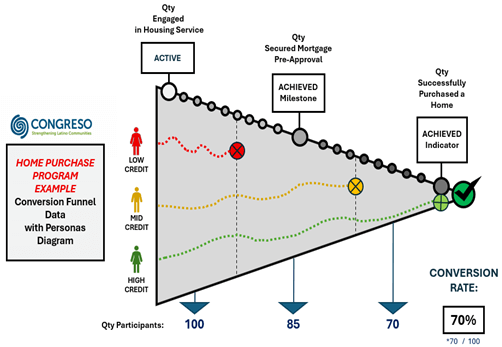
Based on these insights, the team began assessing credit scores as part of the intake process instead of the one-on-one follow-up session. The team also piloted a financial readiness program that was tailored to participants with lower credit scores, focusing on improving their credit scores as an important step before engaging in the homebuying process. Once participants increased their credit scores, they were re-engaged in the main program flow for homeownership. As a result, participant data showed noticeable improvement, and staff successfully pitched the program updates to a funder for ongoing program growth and sustainability. By overlaying CQI principles and HCD tools like conversion funnels and personas, the team identified pain points and a key area of fallout and used that information to improve participant engagement and success rate of the homeownership program.
Examples like these show the tangible benefits for participants, program teams, organization leaders, as well as funders, in embracing HCD as part of the CQI process. Program teams feel empowered to identify and analyze challenges and brainstorm solutions, which has been instrumental in Congreso’s culture shift toward participant-centered performance management. Data-informed insights and solutions empower Congreso’s leadership to support teams by allocating resources, enhancing processes, and sharing impactful stories with funders.
The homeownership program is only one of many stories of HCD providing insights, tools, and techniques for teams to brainstorm and design solutions to improve program performance and impact. Congreso has used HCD across its education, workforce, health, and family programming to better understand the staff and participant experience and believes that these HCD tools are relevant and applicable to any organization looking to enhance its CQI and performance management models.
As your organization is seeking to enhance CQI efforts, consider how process flow diagrams or participant journey maps, conversion funnels, or personas – or any other HCD techniques, might help your organization better understand the nuances of the participant experience and overlay it with your performance management philosophy to drive deeper impact.
Learn From Congreso at SPARK 2025
Congreso’s chief program officer and vice president of programmatic development will present a breakout session at SPARK 2025 on the organization’s HCD journey. Workshop participants will check out Congreso’s Human-Centered Design Toolkit, experience the tools in mini design labs, and learn how these approaches are empowering staff and program participants.
View full event details for SPARK 2025, Oct. 20-21 in Chicago, and register by Sept. 20 to receive the early bird rate.
Across the U.S., nonprofit organizations that provide critical human services, such as foster care, mental health treatment, substance use recovery programs, and elder care, continue to face a liability insurance crisis. Coverage limitations, nonrenewal by their carrier, unaffordable premiums, and carriers exiting the market are among the critical challenges being experienced by providers, regardless of their insurance claim or loss history.
Management liability and cyber insurance costs are projected to fall in 2025 for nonprofits, according to Risk Strategies’ 2025 Insurance Trends Report. However, all other forms of insurance costs are projected to increase 10-30% for nonprofits in the coming year, particularly for general liability (+5-10%), abuse and professional liability (+15-20%), and umbrella (+20-30%) coverage. A 2025 national survey conducted by the National Organization of State Associations for Children (NOSAC) and the Association of Children’s Residential & Community Services reveals the gravity of the situation. Since 2019, respondents reported an average increase of 163% in premiums, with one quarter seeing a premium increase of 200-1800%. Such increases are unsustainable for already under-resourced nonprofits.
Drivers Behind Rising Insurance Costs
Several factors are contributing to this crisis, including:
- High-Risk Work: Providers often care for individuals with significant physical, emotional, or behavioral needs, making the likelihood of incidents, and therefore legal claims, much higher than other sectors.
- Escalating Demand: More families and seniors are seeking care, increasing the chances of incidents and liability.
- Economic Inflation: Inflation has driven up the costs of health care, legal defense, and settlements, making liability claims more expensive to resolve. These higher claim costs are then passed on to providers through increased insurance premiums.
- Staff Shortages: Compounding the problem is a widespread shortage of qualified direct service staff. With fewer workers available to provide care, staff are overburdened, increasing the likelihood of mistakes or oversights that can result in liability.
Resulting Challenges for Providers and Their Communities
Increasing barriers to securing affordable and sufficient insurance coverage poses challenges that are experienced throughout communities.
- As costs reach unsustainable levels, organizations may reconsider the services offered, reduce staff and programs, or delay or discontinue service expansions.
- Without the appropriate insurance, organizations may be unable to continue offering services, even as communities’ needs are increasing. The cost of services also may rise, fostering further challenges for individuals and leaving them without critical supports.
Proposed Policy Solutions
To address this growing crisis, Social Current has proposed a set of policy solutions aimed at making liability insurance more accessible and affordable:
- Public or Captive Insurance Fund: The creation of a public or nonprofit-backed captive insurance fund designed specifically for high-risk service providers could offer more stable and predictable insurance coverage, shielding organizations from the volatility of the commercial insurance and reinsurance market.
- Federal Mandates for Affordable Coverage: Federal legislation that would require states to provide affordable liability insurance options to high-risk nonprofit organizations would ensure that nonprofits are not forced to reduce services or shut down entirely due to rising insurance costs.
- Shared Insurance Pools: Shared-risk insurance pools would allow groups of nonprofits to band together to purchase insurance as a collective, leveraging their combined scale to negotiate better terms and distribute the financial risk.
Without swift and strategic action, the liability insurance crisis threatens to destabilize organizations that families and communities rely on for essential care and support. Social Current emphasizes that this issue demands collaboration across sectors—including insurers, policymakers, and nonprofit leaders—to build long-term, sustainable insurance solutions. By implementing targeted reforms such as public insurance funds, federal mandates and incentives, and pooled insurance models, the sector can protect the future of human services and ensure that communities continue to receive support.
Download this spotlight on liability insurance as a PDF.
Sources and Further Reading:
- Policy Brief: The Growing Liability Insurance Crisis. Social Current. (2024).
- Insuring Care: How Liability Insurance Access Threatens Community Services for Children. ACRC. (2025).
- Illinois community-based foster homes face insurance ‘crisis’. Capitol News Illinois. (2025)
- State of the Insurance Market 2025 Outlook: Nonprofit and Human Services. Risk Strategies. (2025).
- What Is a Captive Insurance Company? Investopedia. (2024).
- Nonprofit Pooling 101. Gallagher. (2024).
Social Current Solutions
Risk Assessment & Reduction
Large-scale solutions are needed to address this complex challenge. Unfortunately, risk mitigation at the organizational level does not necessarily translate to lower insurance costs. Yet, individual organizations can reduce their exposure to liability claims through strategic risk mitigation. Social Current offers several resources to support risk management.
Nonprofit Risk Management Center (NRMC)
The Nonprofit Risk Management Center (NRMC) is a nonprofit dedicated to helping other nonprofit organizations understand and manage the various risks they face. Social Current network organizations have access to NRMC’s extensive collections of risk assessments and tools, including in-depth information on insurance coverage. For access, create an affiliate member account and choose Social Current as the affiliate.
Leadership and Organizational Development Consulting
One of the most effective risk mitigation strategies is building a risk-aware workplace culture. It’s more than just compliance; it’s about proactively prioritizing the recruitment and retention of qualified employees, alongside continuous training. Social Current offers customized leadership and organizational development consulting services designed to ensure your team is well-equipped to perform their jobs expertly and reduce risk for your organization.
COA Accreditation
COA Accreditation, a service of Social Current, provides an evidence-based framework for nonprofit organizations to reduce risks. By requiring adherence to rigorous, research-based standards, COA Accreditation requires organizations to proactively examine and enhance their operations across critical areas like legal compliance, financial management, human resources, governance, and program delivery. This systematic approach ensures the development of clear policies and procedures, robust internal controls, and a culture of accountability, minimizing vulnerabilities to legal challenges, financial mismanagement, and operational failures.
Additionally, COA Accreditation fosters continuous quality improvement and the adoption of best practices, leading to more effective service delivery and better outcomes. Achieving COA Accreditation mitigates internal risks as well as builds external credibility and trust with funders, donors, and the public, strengthening the organization’s reputation.
Knowledge and Insights Center Resources
Business, Media, & Research Databases
From thousands of premium journals to the latest social sector news and media, Social Current Impact Partners and KIC subscribers have access to a wealth of evidence-based resources to support them in addressing any leadership challenge.
About the Knowledge and Insights Center
Social Current’s Knowledge and Insights Center equips social sector professionals with the research and resources they need to stay current on trends, implement best practices, and improve their organizations. It specializes in vetting information sources and systematizing information so that it is easy to understand. Gain access to the Knowledge and Insights Center by becoming a Social Current Impact Partner or purchasing access.
Download this spotlight on liability insurance as a PDF.
Have you heard the saying “Use the right tool for the right job”? When I hear someone offer this recommendation, it is often because that person, usually my spouse, wants to buy more tools. However, joking aside, there is truth to the saying.
It is easiest to fix a problem with the right tool. However, in my experience working with social sector and K-12 educators and administrators, I have observed leaders apply the same strategies to every challenge. I think it is just human nature to go with what we know and to jump into trying to solve the issue at hand. However, repeatedly using the same strategy usually limits progress and can exacerbate the problem. Therefore, before we start selecting our approach to address a challenge, we need to take a step back and diagnose the real problem, and we must uncover the root cause to make lasting change.
Organizational and individual assessments are excellent diagnostic tools for leaders to have in their toolboxes. Assessments provide valuable information for individual leaders, for teams, or for the whole organization. There are many benefits to using an assessment. Here are just a few.
- Individual assessments can help leaders become more self-aware and self-reflective. These are important leadership skills, which are linked to increased productivity, innovation and creativity.
- Individual and team assessments can identify differences and similarities between individual team members regarding perspectives on team challenges and how each team member responds to challenges. Understanding and embracing individual similarities and differences, while applying proven collaboration strategies enhances teamwork and increases innovation.
- Organizational assessments can be used to engage all staff members and assist leaders in a deeper understanding of their organizational culture.
- Sharing the results of an organizational assessment can encourage employee engagement, promote a culture of transparency, and increase staff buy-in for policy and procedure changes.
- The results from organizational assessments can assist in identifying root causes, aid in decision-making, set a baseline for organizational growth, and support organizational change initiatives.
One assessment that provides all these benefits is the Intercultural Development Inventory® (IDI®), which can be used by individuals, teams, or an entire organization. The IDI® is a cross-culturally valid and reliable instrument that measures the way an individual or group experiences cultural differences and similarities. This assessment defines culture very broadly—as someone’s affiliation to a group by generation, nationality, ethnicity, gender, profession, sexual orientation, ability, religion, socioeconomic status, etc.
The IDI® uses a constructive, developmental approach to intercultural competence and can facilitate cooperative conversations and actions directed toward growth. It shows respondents’ placement along the Intercultural Development Continuum (IDC)©. In addition, the exercises provided by the IDI encourage individual self-awareness and self-reflection as well as a pathway for moving forward.
Contact Social Current to Get Started
Social Current consultants are qualified administrators of the IDI® and have extensive experience in collaborating with social sector leaders to strengthen their leadership skills and organizations. Visit our website to learn more about our IDI® and consulting solution and contact us to start a conversation about whether the IDI is the right tool for the right job to help your organization grow.